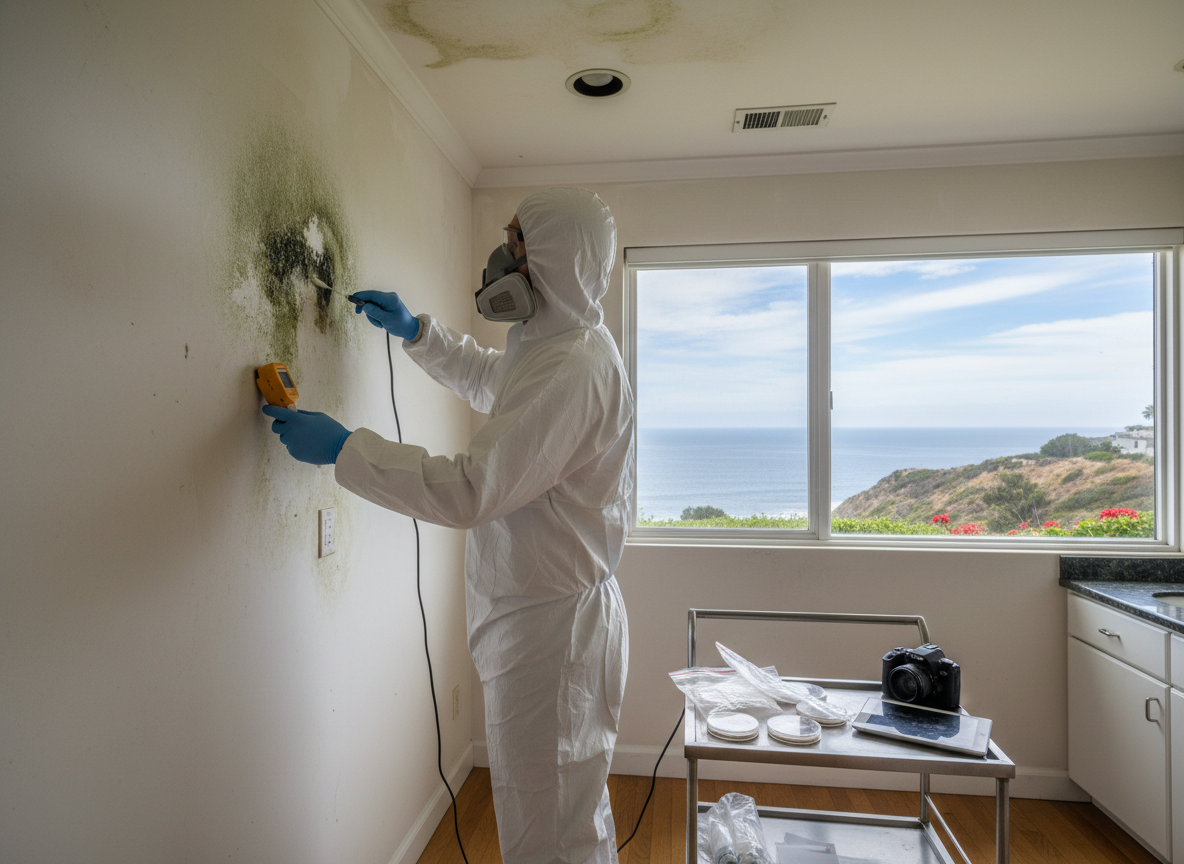
Rancho Palos Verdes sits on coastal bluffs where mild Mediterranean air meets ocean moisture, creating hidden damp zones in crawl spaces and behind stucco on homes built from the 1950s onward. Properties near Portuguese Bend and the Rolling Hills Estates border often sit on shifting terrain that cracks foundations, letting rainwater pool under slabs. We test air, surfaces and wall cavities with calibrated meters rather than relying on visual checks alone, because ocean breezes can mask musty odors even when spore counts are elevated.
Older ranch-style houses near Point Vicente Lighthouse and Los Verdes Golf Course frequently have original plaster and single-pane windows that trap condensation during the brief winter rains. In neighborhoods bordering San Pedro and Palos Verdes Estates, we see more attic mold after fog rolls in from Abalone Cove Shoreline Park. Testing protocols include outdoor baseline samples so we can distinguish normal coastal spores from indoor amplification caused by roof leaks or poor drainage on sloped lots.
Testing near Terranea Resort properties requires extra care around irrigation systems that keep landscaping green but can push water against retaining walls. We document moisture readings room by room and note any HVAC bypasses common in hillside homes. Results guide whether remediation stays limited to one bathroom or expands to adjacent bedrooms where spores have traveled through shared ductwork.
Common Materials and Hidden Locations
We routinely sample drywall paper, carpet backing, and the paper-faced insulation found in most Rancho Palos Verdes tract homes. Edge cases include mold growing on the back side of cultured stone veneer around fireplaces and inside built-in cabinetry against exterior walls that receive constant ocean mist.
Technician insight
In Rancho Palos Verdes the thing that catches most people out with Mold testing near me is assuming ocean breezes keep everything dry. The reality is that fog and winter rain collect against south-facing walls on Portuguese Bend lots, and the stucco on 1960s homes hides saturated drywall paper right behind the weep screed.
Terranea-area townhouse testing
Homeowner noticed a faint odor in the guest bathroom after heavy winter rain. We found elevated moisture at the base of an exterior wall shared with the garage. Sampling showed Aspergillus levels three times the outdoor baseline. We isolated the source to a cracked stucco joint allowing water to reach the drywall, then provided a targeted remediation plan that kept the rest of the house unaffected.
How it works
- 1
Initial Consultation
Discuss visible stains, recent leaks, or musty smells and schedule an on-site visit from our 31204 Palos Verdes Dr W base.
- 2
Visual and Moisture Assessment
Walk every accessible area including attics, crawl spaces and garages while using moisture meters on walls and ceilings.
- 3
Air and Surface Sampling
Collect spore trap and swab samples from suspect locations plus outdoor controls for accurate comparison.
- 4
Laboratory Analysis and Report
Send samples to an independent lab and deliver a written report with photos, readings and recommended next steps.
- 5
Follow-Up Guidance
Explain findings in plain language and coordinate any needed remediation if counts exceed outdoor baselines.
Pricing
Pricing depends on square footage, number of samples and whether crawl space or attic access is required; we provide upfront quotes after the consultation.