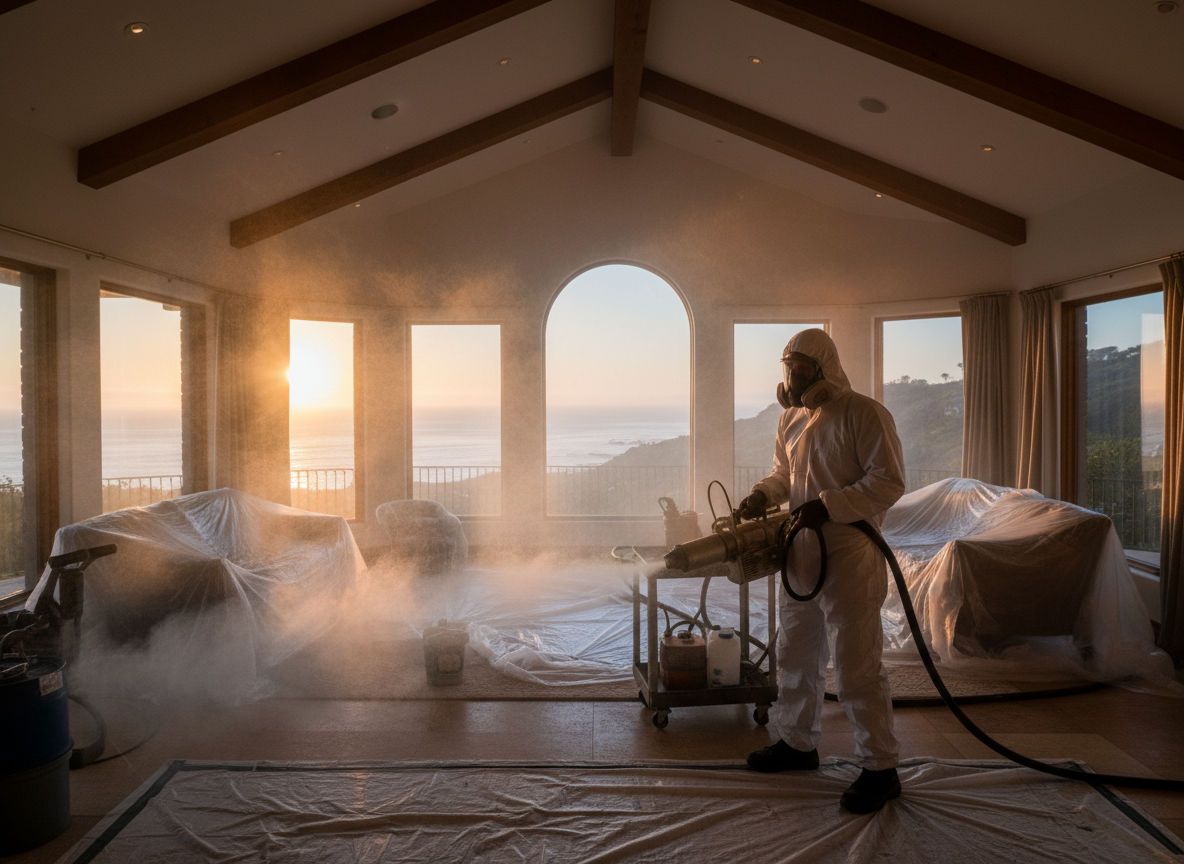
Mold fogging treatment disperses EPA-registered antimicrobials as a dry fog that penetrates behind drywall, into attic insulation and under subfloors without demolition. In Rancho Palos Verdes the mild Mediterranean climate moderated by Pacific Ocean breezes keeps relative humidity elevated year-round, especially in Portuguese Bend and Seaview where older ranch-style homes built on slopes trap condensation in crawlspaces and at the Rolling Hills Estates border. The process requires sealing the structure, running fans to distribute the fog, then ventilating before re-entry. Technicians check for hidden water intrusion from roof valleys or stucco cracks that the fog alone will not fix.
Homes near Terranea Resort and Abalone Cove Shoreline Park often sit on compacted fill with poor drainage, allowing irrigation runoff to wick into foundation walls. Fogging reaches the resulting mold in rim joists and HVAC ducts that surface sampling misses. Los Angeles County building codes require containment and negative air during any remediation that disturbs more than ten square feet, so crews isolate rooms and use HEPA filtration before fogging begins. Homeowners in Palos Verdes Estates and Rolling Hills frequently request this service after repeated surface cleaning fails because the fog contacts spores inside wall cavities that brushes cannot reach.
After fogging, crews perform post-treatment air sampling to confirm spore counts have dropped. In San Pedro adjacent neighborhoods with older plaster walls, the fog can leave a temporary residue on exposed surfaces that wipes clean with a damp cloth. The treatment does not replace source removal when active leaks exist, so technicians always inspect for plumbing or roof issues first. Seasonal Santa Ana winds can dry surfaces quickly but also push spores deeper into attics, making fogging especially useful before the next marine layer returns moisture.
Technician insight
In Rancho Palos Verdes the thing that catches most people out with mold fogging treatment is how ocean breezes push moist air under hillside homes in Portuguese Bend and Seaview; the fog reaches the growth but if you skip checking the crawlspace vents and drainage the spores return within weeks.
Seaview Attic Growth After Marine Layer
Homeowner noticed musty smell in upstairs bedroom after weeks of heavy fog. Inspection found condensation on roof sheathing and mold on insulation above the master closet. Crew isolated the attic, ran fog through the entire upper level, ventilated, and confirmed clearance with air samples. Odor was gone and no recurrence reported after improved attic venting was added.
How it works
- 1
Inspection and Containment
Technicians walk the property identifying moisture sources and set up plastic barriers with negative air machines to isolate the treatment zone.
- 2
Preparation and Sealing
HVAC vents are covered, occupants and pets leave, and all exterior doors and windows are sealed to keep the fog inside the structure.
- 3
Fog Application
Antimicrobial fog is released from multiple points and circulated with fans for the required dwell time to contact hidden surfaces.
- 4
Ventilation and Clearance
The home is aired out, surfaces are wiped where needed, and clearance air samples are collected before re-occupancy.
Pricing
Cost depends on square footage treated, number of zones, and whether containment or post-testing is required.