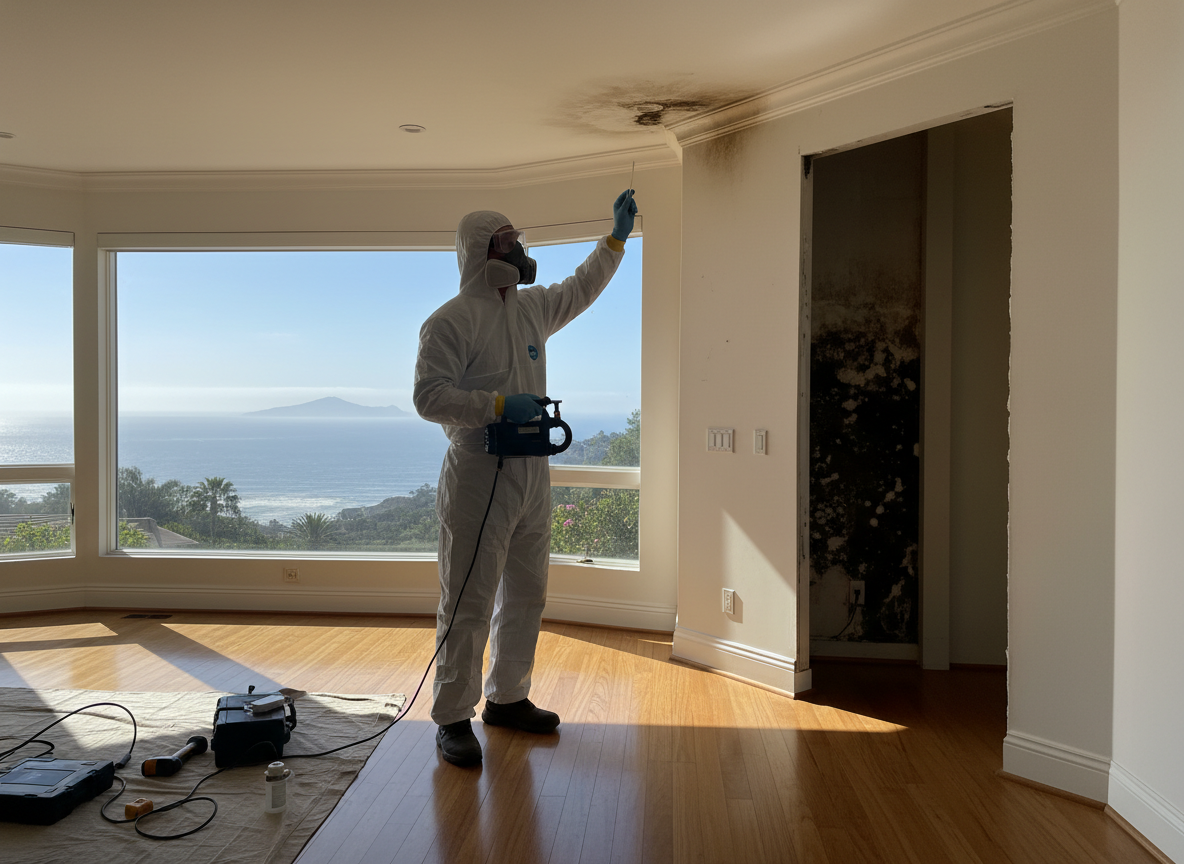
Rancho Palos Verdes sits on a coastal bluff where Pacific breezes meet mild Mediterranean air, yet winter fog and occasional heavy rains drive moisture into crawl spaces and behind stucco in homes built from the 1950s through the 1980s. Portuguese Bend and Seaview neighborhoods contain many single-story ranch houses with slab-on-grade foundations that trap condensation when ocean humidity spikes. Emergency mold testing here requires immediate air and surface sampling plus moisture metering of drywall, insulation, and subflooring before visible growth spreads to adjacent rooms.
Homes along the Rolling Hills Estates border and near Point Vicente Lighthouse often feature older HVAC systems and single-pane windows that allow temperature swings, creating hidden condensation lines inside wall cavities. Testing protocols must account for salt-laden air that accelerates corrosion on metal framing and ductwork. Technicians document spore counts room-by-room, noting any prior water intrusion from roof valleys or hillside drainage issues common on the peninsula.
Los Angeles County building codes require proper containment and negative-air protocols during any invasive testing near occupied spaces. In Terranea and Abalone Cove areas, steep lots mean runoff can enter lower-level garages and laundry rooms after storms. Emergency calls frequently involve post-leak verification after pipe repairs or after high-wind events that drive rain under tile roofs common throughout Rancho Palos Verdes.
Testing also covers Los Verdes Golf Course-adjacent properties where irrigation overspray raises exterior soil moisture against foundation walls. Results guide whether remediation stays limited to one wall or expands to entire HVAC runs. All samples are sent to independent labs for same-day turnaround when health symptoms are reported.
Technician insight
In Rancho Palos Verdes, the thing that catches most people out with emergency mold testing services is hidden moisture trapped behind stucco on north-facing walls near Abalone Cove Shoreline Park. Ocean fog sits against those elevations longer than inland spots, so a small leak from a window flashing often travels several feet inside the wall before any stain appears inside. Skipping moisture meter checks on the exterior side of the framing misses the real source every time.
Post-storm testing in Seaview
Heavy rain pushed water under a tile roof in a 1960s Seaview home. Visible ceiling spots appeared two days later. Testing located elevated moisture and mold spores in the attic insulation and one bedroom wall cavity. Containment was set, samples collected, and the report allowed targeted removal of only the wet insulation before growth reached living areas.
How it works
- 1
Initial Phone Assessment
Gather details on recent leaks, visible spots, or musty odors while confirming address in Portuguese Bend, Seaview or nearby neighborhoods.
- 2
Rapid Site Arrival
Technician reaches the property within hours from the Palos Verdes Dr W base, sets up containment, and begins visual inspection.
- 3
Targeted Sampling
Air, swab, and bulk samples taken from affected zones plus control areas; moisture readings recorded on drywall, wood, and insulation.
- 4
Lab Analysis & Report
Samples processed same day; written findings delivered with photos, spore counts, and clear next-step recommendations.
- 5
Follow-Up Guidance
Discuss results and coordinate any needed remediation while respecting 24/7 availability for urgent cases.
Pricing
Upfront quotes provided after phone assessment; cost driven by square footage tested and number of samples required.