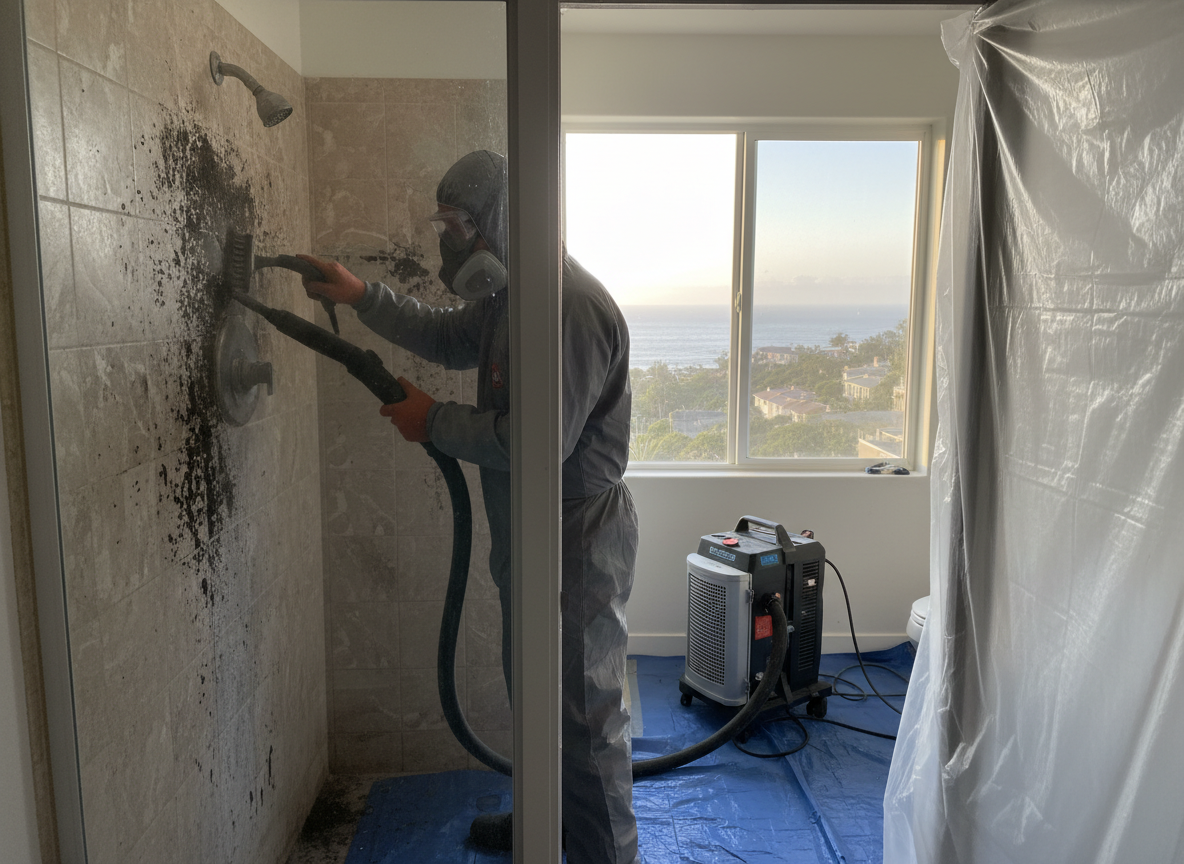
Rancho Palos Verdes homes built along the Portuguese Bend and Rolling Hills Estates border often feature original 1960s-1980s tile and plumbing that allows slow leaks behind showers to feed mold colonies without obvious surface signs. The mild Mediterranean climate moderated by Pacific Ocean breezes keeps outdoor air moderate yet traps humidity inside bathrooms when windows stay closed during the cooler marine layer months. Technicians must pull back baseboards and inspect the subfloor because hillside settling near Abalone Cove Shoreline Park shifts foundations enough to crack grout lines and let water reach wall cavities. Containment barriers and negative air machines become essential in these layouts to stop spores from drifting into adjacent bedrooms or hallways.
Near Terranea Resort and the Seaview neighborhood, many bathrooms sit above garages or on upper levels where roof valleys direct rainwater toward vent stacks that later leak into ceiling drywall. Removing mold here requires cutting out sections of gypsum board while preserving the integrity of the surrounding plaster that older Los Angeles County homes still contain. Homeowners frequently discover the issue only after noticing a musty smell during the brief winter rains, when indoor humidity spikes despite the ocean moderation. Proper drying with commercial dehumidifiers sized for the square footage prevents regrowth once the source is sealed.
Service calls in Palos Verdes Estates and San Pedro border zones commonly involve post-remediation verification using moisture meters on concrete slab edges, because ocean proximity raises baseline soil moisture that can wick upward through slab edges into bathroom flooring. Technicians document every step with photos for insurance adjusters familiar with claims from this coastal stretch of Los Angeles County. Final clearance testing confirms spore counts match outdoor baselines before any new tile or paint is installed.
Technician insight
In Rancho Palos Verdes, the thing that catches most people out with bathroom mold removal service is how ocean breezes keep the house feeling dry while the marine layer pushes humidity into older shower pans along Portuguese Bend roads; homeowners keep running the fan for ten minutes and still end up with black growth behind the tile because the weep holes are clogged from decades of hard water deposits.
Shower Leak Behind Tile in Seaview
A homeowner near Seaview noticed a persistent musty odor after winter rains. Inspection found water had traveled under the shower pan and into the subfloor joists. We removed the affected tile and drywall, dried the framing for four days, treated the wood, and reinstalled new backer board and tile. Clearance testing passed and the odor did not return.
How it works
- 1
Initial Inspection
Technician arrives at the Rancho Palos Verdes address and uses moisture meters plus borescopes to map hidden growth behind tile and under vanities without disturbing the structure.
- 2
Containment Setup
Plastic barriers and negative air machines isolate the bathroom to prevent spores from reaching living areas in homes near Point Vicente Lighthouse or Los Verdes Golf Course.
- 3
Removal and Cleaning
Affected drywall, baseboards, and grout are removed, surfaces are treated with EPA-registered antimicrobials, and debris is bagged for disposal following Los Angeles County guidelines.
- 4
Drying and Verification
Commercial air movers and dehumidifiers run until readings drop below 15 percent, followed by independent air sampling to confirm clearance before reconstruction begins.
- 5
Prevention Recommendations
Client receives a written report noting specific fixes such as exhaust fan upgrades or caulk replacement suited to ocean-breeze humidity patterns in the area.
Pricing
Cost depends on square footage affected, depth of hidden growth in older hillside construction, and whether slab-edge moisture requires extended drying.