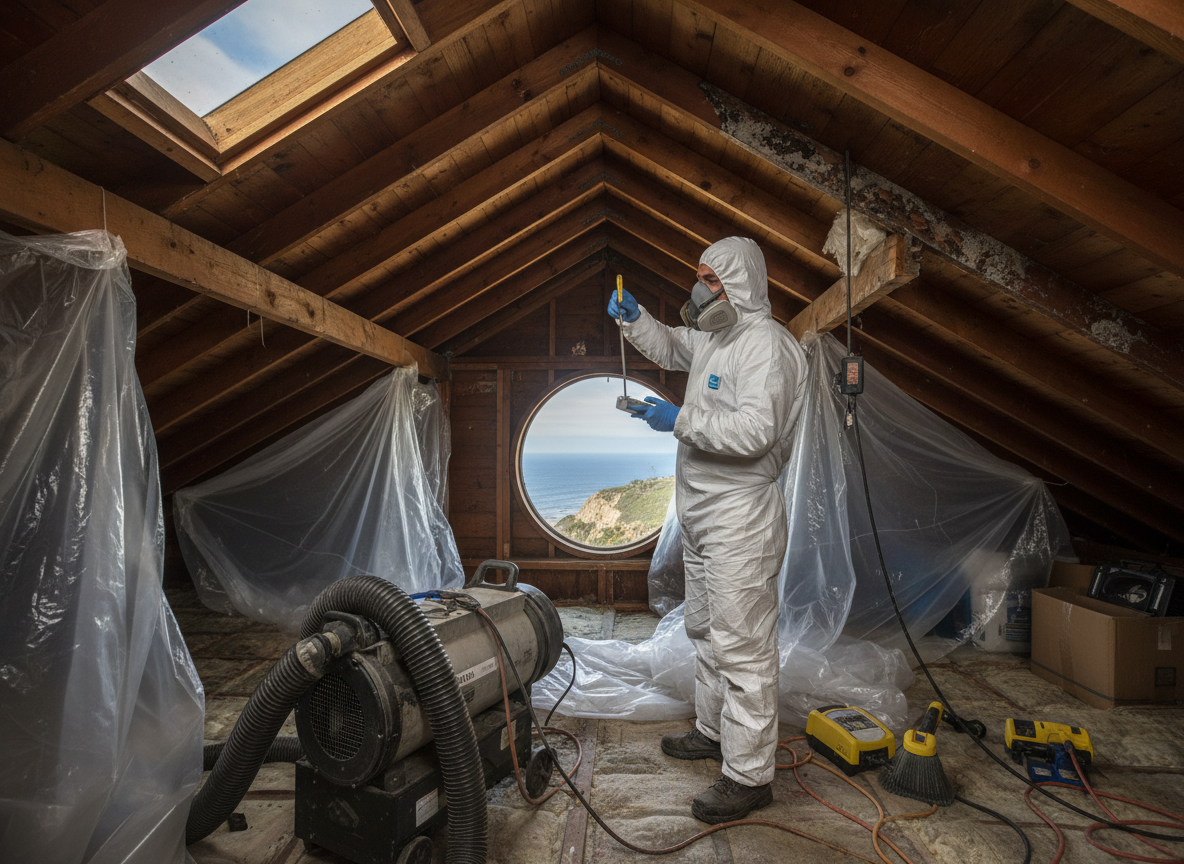
Rancho Palos Verdes homes built along the Rolling Hills Estates border and in Portuguese Bend often feature older attics with minimal ridge venting and original fiberglass batts that trap condensation from mild Mediterranean air moderated by Pacific Ocean breezes. These conditions allow mold to establish on roof sheathing and trusses even without obvious roof leaks, especially where coastal fog lingers overnight. Technicians must account for the steep hillside terrain that limits equipment access and requires careful containment to prevent spores from drifting into living spaces below.
Testing begins with moisture mapping and air sampling at multiple attic points, followed by surface lifts to identify species common in Los Angeles County coastal zones. Removal protocols include HEPA vacuuming, antimicrobial treatment of wood members, and insulation replacement only where saturation exceeds safe thresholds. Edge cases arise near Point Vicente Lighthouse and Abalone Cove Shoreline Park properties where salt-laden air accelerates corrosion on metal fasteners, complicating sealing after remediation.
Homeowners in Seaview and near Los Verdes Golf Course frequently discover hidden growth during re-roofing projects when contractors open the attic. Proper negative-air setup and post-removal clearance sampling prevent recurrence tied to the area's consistent humidity. Work follows Los Angeles County guidelines for residential structures without requiring permits for non-structural mold removal unless drywall or framing is involved.
Technician insight
In Rancho Palos Verdes, the thing that catches most people out with Attic mold testing and removal is how Pacific Ocean breezes push moisture into attics of 1960s and 1970s homes in Portuguese Bend and Seaview where original insulation has compacted and blocked soffit vents.
Hidden Growth Discovered During Roof Work
A homeowner in Terranea noticed musty odor after roof replacement. Inspection revealed mold on sheathing where ocean moisture had condensed behind settled insulation. Containment was set from the exterior access point, affected materials removed, and surfaces treated before clearance samples passed.
How it works
- 1
Initial Assessment
Technician inspects attic access points and maps visible moisture and growth using moisture meters and borescopes.
- 2
Air and Surface Testing
Samples are collected from multiple zones and sent for lab analysis to confirm mold types and spore levels.
- 3
Containment and Removal
Plastic barriers and negative air machines isolate the attic while affected insulation and growth are extracted.
- 4
Treatment and Clearance
Wood surfaces receive antimicrobial application followed by independent clearance testing before barriers are removed.
Pricing
Cost depends on attic square footage, insulation depth, and whether access requires scaffolding on hillside lots; upfront quotes provided after inspection.